Posts

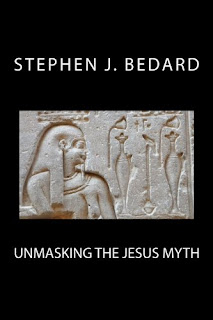
Book Review: Unmasking the Jesus Myth by Stephen J. Bedard
Image
      [Following is a slightly revised version of a review that can be found at Amazon .)   The back cover to Stephen J. Bedard’s Umasking the Jesus Myth reads, "This book puts forward the evidence for Jesus and exposes the false claims of the Jesus Myth theory." I give Unmasking the Jesus Myth five stars because it fulfills its stated purpose effectively and succinctly.   Having previously coauthored (with Stanley Porter) the award-winning Unmasking the Pagan Christ , and now leading the Hope's Reason Ministries, Bedard is well equipped to unravel the often tangled web of Jesus myth speculations. His relatively compact survey first traces the history of the movement, beginning with the theologically-stripped “historical Jesus” proposed by Albert Schweitzer, followed by the increasingly skeptical concepts of, for examples, Bruno Bauer, G.A. Wells, Earl Doherty, Robert Price, D.M. Murdock (aka Acharya S.), Timothy Freke and Peter Gandy, and  ...

Fun with the modal argument

Image
This is one of the most complex issues there is,especially Hartshorne's version which I use,or one similar to his. On Victor Reppert's Dangerous Idea Blog I found our old friend Stardust makimng the claim that there are no valid arguments for God. As it turns out he didn't know what valid meant. He didn't know in logic it refers to the technical presentation of the argumet Arguments must be both valid and sound, soundness refers to truth. After dancing around that for a bit I decided to just challenge him to debate the modal argument. My argument: 1. God is either necessary or impossible. 2. God can be conceived without contradiction. 3. Whatever can be conceived without contradiction is not impossible. 4. God is not impossible. 5. God is necessary. 6. That God's existence is necessary is a good reason to believe that God is real. 7. Therefore, believe in God's reality is warranted. Notice I don't say god's "existence,"...

Is the Trinity Logically Impossible?

Image
One of the various disagreements I had with IM Skeptical regarding my recent post, "Should Philosophy of Religion Be Ended?", concerned whether there are possible worlds in which the laws of logic do not hold. I maintain that the laws of logic must hold at every possible world if the very concept of "possible worlds" is to have any meaning whatsoever. Once it is permitted that the rules of logic are not themselves necessary truths, we are left with no means to distinguish possible truths from necessary truths, let alone possible worlds from impossible worlds (e.g., worlds that both exist and do not exist at the same time). Skeptical, in order to refute arguments for God from logic – like the "Lord of Non-Contradiction" paper by Anderson and Welty – to the contrary contends that there may be possible worlds in which rules of logic do not in fact hold.   Skeptical then suggested that despite their appeals to logic theists make special exceptions f...

The Nature of Biblical Revelation

Image
Atheists on the internet are always talking about contradictions in the Bible. These alleged contradictions fall into many categories. Most can be extinguished simply by remembering that all language had connotative meanings and all good writing uses literary devices, but many are based upon an inadequate understanding of the nature of divine revelation. The problem is that most of these atheist notions of "contradiction" are only contradictions becuase they are judged according to the fundamentalist model, veral plenary inspiration, (aka "inerrancy") by which the Bible is understood as literal and perfect. Actually the model used for this concept is similar to the notion of the boss of company writing a memo to the employees. Dictated to a secretary but every word in the memo is exactly what the boss wants to say, the whole is literally the word the of the boss. The problem with the notions of revelation in the Christian tradition is that they are ba...

Is Inerrancy a Heresy? Part 2

For Part 2 of my look at Rodger Cragun's The Ultimate Heresy (TUH), which claims that the doctrine of inerrancy is heretical, we first look at examples in which he supposes he has shown that what is found in the text is incompatible with inerrancy. As we have noted last time, however, while what Cragun presents would cause problems for a hyper-fundamentalist view of inerrancy, it would have little bearing on a contextualized understanding of the doctrine. He also presents far fewer arguments than I expected him to provide -- in fact, what he offers amounts to three broad arguments: Jesus broadened or sometimes placed restrictions on the law. This shows that he didn't consider it inerrant. Cragun offers multiple examples of how Jesus either broadened or narrowed the OT law, but Cragun could have saved himself the trouble, and spared the reader pages of irrelevant examples. As we have noted in numerous contexts, the OT law was didactic, which means that it was ne...

A Botched Abortion Shows the Lies of Pro-Choice Proponents

One of the classes I teach at the university is a course on Ethics, and I am using a book by Ralph Dolgoff, Donna Harrington and Frank M. Lowenberg entitled " Ethical Decisions for Social Work Practice " as the text. Overall, I think that it is a good Ethics textbook largely because it provides a balanced viewpoint on the need for values in social work. For example, the book makes the argument (without committing to it) that those engaged in social work cannot avoid making value judgments in ethical decisions because trying to do what is right necessarily involves making an value choice. Also, I book notes that some (including me) think it is ethically wrong for a social worker to cover-up her own values when counseling another person because it creates a false (and ultimately unproductive) relationship with the person being counseled. Still, one of the exemplars in the book gave me pause – not because I thought it raised a deep ethical quandary, but because I wondered how ...

Causality in Miracle Hunting.

Image
In the discussions of miracles several atheists have made some big misconceptions. (1) mistaken assumptions about my knowledge of correlation and cause. some assume that since they are clever enough to know the very basic information, the difference in correlation and causality, that I must not know that because I'm a Christian and Christians are stupid, and they are so very clever to know some basic fact that all high school kids should get, correlation is not causality. But what they don't get is that just as I argue inductively that correlation is indicative of a cause if certain conditions obtain, that doesn't mean I don't know the difference. (2) Correlation is indicative of Cause. What these very clever atheists don't get is that correlation is indicative of cause. part of the problem is that certain people don't seem know what indicative  means. Be that as it may, there is an epistemological gap in our knowledge it is a ...

Thoughts on NIcholas Kristof and Pastor Timothy Keller's Conversation: "Am I a Christian?"

I am not a big fan of Pastor Timothy Keller. I mean, I have read a couple of his books and there is nothing particularly wrong in what he has to say that I have seen, but for some reason his books have left me largely uninterested. But today, I came across an interview that he did with Nicholas Kristof of the Gray Lady where the aforementioned liberal/progressive op-ed columnist for America's Newspaper of Record decided to use Pastor Keller as the expert to ask his questions about the truth of Christianity around Christmastime. The article entitled " Am I a Christian, Pastor Timothy Keller? " was run two days before Christmas, and asked questions akin to, "Does everyone who does not believe the truth of the entire Bible go to hell?" and "Why aren't the Gospels clear or consistent on Jesus' resurrection?" Over at Breitbart News, Charles Hurt read Kristof's article and interpreted it as an attack on Christianity by Mr. Kristoff on one of Ch...