Posts

Showing posts with the label New Testament

Our Prayers for Professor Larry Hurtado

Image
I don't know how many people read the blogs we reference on the side of this blog, but some of them are really excellent. Sadly, I will shortly be removing one because it will soon become a site with no new material. As stated on Larry Hurtado's blog , Prof. Hurtado is "a scholar of the New Testament and Christian origins, with posts in higher education since 1975. In August 2011, I retired from my post as Professor of New Testament Language, Literature & Theology (University of Edinburgh) in which I served from 1996. Prior to that, I was in the Department of Religion, University of Manitoba (Winnipeg). My own research over the decades has focused mainly on the origins and development of 'devotion to Jesus' in earliest Christianity, and also on textual criticism and the study of earliest Christian manuscripts as informative artefacts of ancient Christianity." Prof. Hurtado has posted some really excellent articles over time about various NT frag...
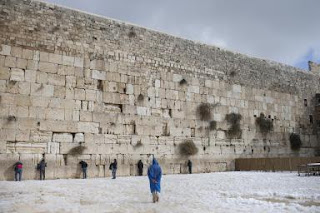
The Skeptics' Effort to Dismiss Jesus' Prediction of the Destruction of the Temple

Image
Over at Cold Case Christianity , the extremely informative website of J. Warner Wallace (who I would like to call a friend to our blog since he has tweeted several of our posts over the past few months, but I have never spoken to him in person), Mr. Wallace (hereinafter, JWW) posted an article entitled " Does the Temple Prediction Invalidate the Early Dating of the Gospels? " responding to challenges raised by skeptics arising from Jesus' prediction of the fall of the Temple in Jerusalem. What exactly is the problem with Jesus having predicted the fall of the Temple? Nothing actually, unless the people raising the challenge are wedded to a viewpoint that says that it is impossible for anyone to prophesy because that would mean that they know the future - which is impossible. For those unfamiliar with Jesus' prophesy that the temple would be destroyed, it is repeated in three places in the Bible, Matthew 24:1-2, Luke 21:5-6 and Mark 13:1-2. All three of the predictio...

John the Baptist's Bones Found?

'John was clothed with camel's hair and wore a leather belt around his waist, and his diet was locusts and wild honey. And he was preaching, and saying, "After me One is coming who is mightier than I, and I am not fit to stoop down and untie the thong of His sandals. I baptized you with water; but He will baptize you with the Holy Spirit."' Mark 1: 6-8 John, the cousin of Jesus of Nazareth, is the first name mentioned (other than the name of Jesus himself) in what is commonly believed to be the earliest of the Gospels. Despite a lot of information contained in the New Testament about John the Baptist, there is little external evidence that he ever lived. Certainly, he is mentioned in Flavius Josephus, Jewish Antiquities 18.109ff where Josephus confirms that John the Baptist was "put to death" by Herod. The relevant language reads: Now some of the Jews thought that the destruction of Herod's army came from God as a just punishment of what Herod had do...

Was Suppression of Options for New Testament Canon Only Due to Imperial Pressure?

It's pretty normal nowadays for revisionist historians and commentators, when promoting the "lost texts" of early Christianity, to lambaste Imperial Rome for imposing a canon-from-above, and for outright destroying competitive texts, in a bid to force compliance with Imperial ideas of orthodoxy. This is almost hilarious as a claim throughout most of the 4th century (300s CE), since the ruling elite during most of that time were one or another kind of Arian, not of the "Orthodox" party. (Arians believed either that Christ was a lesser created deity taking human form, or more popularly that Jesus was a totally human hero promoted up by God the Father to deity status. Not unlike typical claims for previously pagan Emperors, by the way.) Still, the fact of the matter is that there were indeed document purges in the Roman Empire during the Christian history (including the trinitarian Christian history) of the Western and Eastern Empire. So it isn't unreasonable, ...

Doherty part 4: Rise of the Q Community

Image
refutation of Doherty's Evolution of Jesus (4 of 7) Doherty assumes what we have just disproved, the latter development of Cross and tomb, in order to assert a fictional Q community that lacked knowledge of Jesus and set up the basic Q document: "If, on the other hand, the "biography" of Jesus of Nazareth was something unusual which went against the grain of current knowledge and belief, one can understand how early versions of the Gospels, written around the turn of the century, would have enjoyed only limited use and isolated reworking for at least a generation." The Gospels would certainly be limited in acceptance even if the cross and the tomb were early and well known. Doherty wants us to think its because something totally new is being introduced into a tradition that never had it before, and that is true, but that doesn't mean the new element is the cross/tomb part of the story, nor is it an earthly Jesus. What's new is the introduction of writte...

Colossians and the Historicity of Christ

Over at the excellent Thinking Christian blog, Tom Gilson has written an very good, short piece about the book of Colossians and it's implictions to the idea that Jesus was deified by the early church. Entitled Colossians and the Implausibility of the Fable Theory , he makes the point that the book does't make sense if Jesus was only later deified by the church. I really like the following point he makes in terms of evaluating the Epistle in light of the idea that if Jesus was deified by the early church, it must have been to some purpose. Tom's answer is short and resounding: Is there any hint that Christ is being used as a means to an end? None whatever. Rather he is the end himself, the object of reverence and worship. It seems implausible that the early church community would have built up a Christ-fable as a means to their survival under persecution, without some taint of that intention touching documents like this. Absolutely. That seems so stunningly obvious that w...

Ben Witherington on Hebrews

Ben Witherington III, Ph.D., Amos Professor of NT for Doctoral Studies at Asbury Theological Seminary and author of multiple books, including What Have They Done with Jesus?: Beyond Strange Theories and Bad History--Why We Can Trust the Bible , has published on his blog a very interesting article entitled The Rhetorical Character of Hebrews . This entry is apparently the text of a lecture he is (or was) scheduled to give at the Society of Biblical Literature lecture. At the outset, he takes up the question about the authorship of Hebrews. Of course, there have been numerous theories as to who wrote the book (including some that identify the author as the Apostle Paul), but rather than focus on the "who", he focuses on "why" there is no author identified. It is of course possible that the author is so well known to the audience that there was no need for such an identification here. I would suggest however, that while that may be true, there is another primary reason...

The Case for the Real Jesus

A long running fad in some circles is to try to find the "historic Jesus." In this line of thought, the "historic Jesus" cannot be the same Jesus that we find in the Bible. Instead, the "historic Jesus" must be some interesting historical figure (such as a eschatological preacher) who has been layered in myth and clothed in deity by his followers. He certainly wouldn't have claimed to be God (since there is no personal God) and he would have been appalled at what today's Christians would have made of him. People like John Dominic Crossan, Marcus Borg and the Jesus Seminar promote this view in their books (that are always more abundant on the shelves at Barnes and Noble and Borders than the books by more conservative scholars like William Lane Craig or J.P. Moreland). Fortunately, while this fad belief gets far more publicity (especially around Christmas and Easter), at least one author who rejects this view and makes the case for historic Christian...

Archaeological Confirmation of Acts 18:2

I am often impressed by how the New Testament is constantly being confirmed by archaeology. Old beliefs that certain people or places never existed are constantly stripped away by the hard work of archaeologists who uncover evidence that the people and places described in the Bible existed and that the Bible is accurate in its descriptions. The fact that it is accurate in those things that we can confirm (even before we were able to confirm them) gives testimony to the belief that we can trust the Bible in those things that cannot or have not yet been confirmed. Recently, I came across an article entitled Archaeology and the Bible: How archaeological findings have enhanced the credibility of the Bible by John McRay which gives a listing of some of the finds that have supported the Bible. In the article, Mr. McRay points to several of the better known finds such as the Tomb of Caiaphas and the Pool of Siloam. However, Mr. McRay points to another archaeological confirmation of which I w...

Historical Validity of the Gospels

Image
In response to the comments on the huge post by Brain2 that was removed, "anonymous" makes the comment: Because Jesus didn’t write the bible. From his alleged words (of which no one could’ve possibly scribed in wax, ink, or stone as quickly as he would’ve spoken) to the Bible you have in your hands is at LEAST 5 generations of hearsay, interpretation, and the good old game of “telephone”. I was being generous. It’s probably more like 10th- or 12th- hand accounts, what you are reading. That is, unless you’ve read the original tablets, scribes, and scrolls… which would themselves be at least 3rd- or 4th- hand themselves." This is a pretty standard spin for most atheists on the boards. It's not that we have failed to refute it many times. Although, we have allowed atheists to remove the bible from the debate. We have allowed them to speak of it as garbage so many times that they just think of it as almost non existent. For the practical purposes of documenting Jesus lif...

Richard Baukham Interview in Christianity Today

Today's Christianity Today has an interview with Richard Baukham, author of Jesus and the Eyewitnesses , entitled They Really Saw Him . Set up in a Q&A format, the article has some interesting insights into his book. What it the importance of "testimony" for interpreting the New Testament? I think it helps us to understand what sort of history we have in the Gospels. Most history rests mostly on testimony. In other words, it entails believing what witnesses say. We can assess whether we think witnesses are trustworthy, and we may be able to check parts of what they say by other evidence. But in the end we have to trust them. We can't independently verify everything they say. If we could, we wouldn't need witnesses. It's the same with witnesses in court. Testimony asks to be trusted, and it's not irrational to do so. We do so all the time. Now in the case of the Gospels, I think we have exactly the kind of testimony that historians in the ancient world ...