Posts

Showing posts with the label Christian history

Does a Tiny Earth in a Vast Universe Mean Humanity is Insignificant?

Image
The truth : Even ancient thinkers recognized that the earth was tiny in relation to the immense cosmos. In any case, size doesn’t necessarily mean significance, as many theologians and philosophers recognized. ~ Dr. Michael Newton Keas Last time , I posted about a book dealing with science, history and Christianity that had graciously been made available for free both through Academia.com and Amazon.com by Dr. Michael Newton Keas entitled Unbelievable: 7 Myths About the History and Future of Science and Religion . As part of that blogpost, I quoted part of the book’s introduction where Dr. Keas raised the supposed problem for God’s existence arising from the existence of an insignificantly small Earth in an almost incomprehensibly vast universe. He identified the myth: “Premodern scholars in the Western tradition thought the universe was small—a cozy little place just for human benefit. Modern science displaced this Church-sanctioned belief with a vast cosmos that revealed humans ...
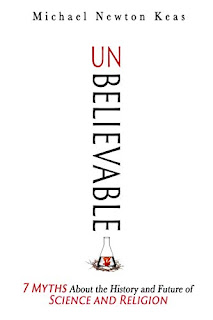
Unbelievable: An Apologetics Book Available for Free for a Limited Period of Time

Image
I am going to say something that many people will not immediately accept, and I fully imagine that I will catch grief for saying it. But here it goes: People are constantly spreading untruths about Christianity. I know, I know. For some readers this is a real shocker. They have been told by other non-Christians certain “truths” about God, the Bible and Christianity, and they had no reason to believe that they were untrue. I mean, c’mon, we all know that Christopher Columbus proved that the Earth was really round to the stunned disbelief of the anti-science, flat-earth believing Church, right? Except that it isn’t what happened at all . The new resource is from Dr. Michael Newton Keas, who earned a PhD in the history of science from the University of Oklahoma, presently serves as an adjunct professor of the history and philosophy of science at Biola University, and who is a senior fellow of Discovery Institute. Dr. Keas has made available for free his book, Unbelievable: 7 My...

A Good Quote

In his short essay entitled "On the Reading of Old Books", C.S. Lewis says that it is important to read old books in order to be less suseptible to the prejudices and outlook of one's own age. Lewis notes: Every age has its own outlook. It is specially good at seeing certain truths and specially liable to make certain mistakes. We all, therefore, need the books that will correct the characteristic mistakes of our own period. And that means old books. Lewis recommends the reading of one old book for every three new ones -- a habit I highly endorse. And while reading the old books help point out the characteristic mistakes of our own period, they also point out when a particular attitude that is thought to be new to our own period is actually much older. These attitudes, moreover, are not only reflected in the non-fiction work, but the fiction work may sometimes illustrate an attitude or outlook with much more grace and eloquence than can be found in the non-fiction arena. ...

Colossians and the Historicity of Christ

Over at the excellent Thinking Christian blog, Tom Gilson has written an very good, short piece about the book of Colossians and it's implictions to the idea that Jesus was deified by the early church. Entitled Colossians and the Implausibility of the Fable Theory , he makes the point that the book does't make sense if Jesus was only later deified by the church. I really like the following point he makes in terms of evaluating the Epistle in light of the idea that if Jesus was deified by the early church, it must have been to some purpose. Tom's answer is short and resounding: Is there any hint that Christ is being used as a means to an end? None whatever. Rather he is the end himself, the object of reverence and worship. It seems implausible that the early church community would have built up a Christ-fable as a means to their survival under persecution, without some taint of that intention touching documents like this. Absolutely. That seems so stunningly obvious that w...

How Should I Be a Sceptic -- one brief history of the reason/faith dichotomy

[Introductory note from Jason Pratt: the previous entry in this series of posts can be found here. The first entry can be found here. ] There are many devout people who rightly (I believe) value a faith in God above all other possessions, but who will also see my attempts as striking against a true relationship with God. I think they are quite correct (as I will discuss much later) that it is better to have a living relationship with God and to work with Him, than only to understand God in some technical sense. Furthermore, I agree that if it is possible to discover the existence and character of God by reasoning from neutral propositions, this neither can nor shall ultimately benefit the thinker unless he takes the next step and chooses to work with God personally. [See first comment below for a footnote here.] But although I agree with these notions, I do not think it logically follows from these notions that such a discovery by logical analysis must necessarily fail. Consequently...